PDFlibPas fixed two independent faults in its native JBIG2 halftone region decoder: in v3.539.37 the HSKIP skip mask is indexed as HSKIP[ng, mg] as ITU-T T.88 §6.6.5.1 defines it, and in v3.539.38 grids that reach negative coordinates, through a negative HGX or HGY or through rotation, are placed with a true floor shift. Before those releases, affected halftone regions came out garbled or displaced, with no error raised. Both bugs hid behind test data that happened to be symmetric or non-negative, and the second one turns on a property of Delphi and Free Pascal that bites far outside JBIG2: shr on a signed integer is a logical shift, not the arithmetic >> the standard assumes
Halftone regions are the least common JBIG2 region type, so a decoder can process thousands of scanned documents before it meets a screened photograph encoded as one. When it does, the failure is nasty: the file parses, the segment lengths add up, the page has the right size, and the region is garbage
What does a JBIG2 halftone region actually decode?
A JBIG2 halftone region is a grid of small bitmaps picked from a pattern dictionary, and the decoder's real work is computing an index for every grid cell and the pixel position where that cell lands. The pattern dictionary holds HNUMPATS patterns of HPW × HPH pixels. The halftone region segment then describes a grid of HGW columns by HGH rows and a gray-scale image of the same size, coded as Gray-coded bitplanes. Each bitplane is decoded with the generic region procedure over an HGW × HGH bitmap, most significant plane first, and the planes together give each cell its pattern index
Cell placement uses fixed-point arithmetic with an 8-bit fraction. The grid origin HGX, HGY is a pair of 32-bit values, and the grid vector HRX, HRY describes the step between neighboring cells, which allows a rotated grid. For grid row mg and grid column ng, T.88 §6.6.5 computes the pixel position as:
x = (HGX + mg × HRY + ng × HRX) >> 8y = (HGY + mg × HRX − ng × HRY) >> 8
The skip mask enters through the optional HENABLESKIP flag. When the flag is set, §6.6.5.1 builds an HGW × HGH bitmap HSKIP and sets HSKIP[ng, mg] to 1 for every cell whose pattern lies entirely outside the region: x + HPW <= 0, x >= HBW, y + HPH <= 0 or y >= HBH. The gray-scale bitplanes are then decoded with that mask as the generic region skip bitmap, so the arithmetic decoder neither reads nor updates context for a skipped cell. Decoder and encoder must agree on every bit of HSKIP, or the two arithmetic coders fall out of step
Why did a transposed HSKIP mask only break non-square grids?
The skip mask was written with its coordinates swapped, and only a non-square grid exposed it, because a square grid keeps every swapped coordinate inside the mask. PDFlibPas stores bitmaps with a (column, row) pixel accessor, and the code that built the mask passed (mg, ng), row first. The gray-scale bitplane decoder reads the mask correctly as (ng, mg). The pattern placement loop read it back in the builder's swapped order, so the two agreed, and a review of the placement logic alone would pass it. A naming trap made that worse: in the placement loop the variable called col iterates grid rows and Row iterates grid columns
Take the 5 × 3 grid of 4 × 4 patterns on a 16 × 8 region that v3.539.37 uses as its regression case. With HRX = 1024 and HRY = 0, grid column 4 lands at x = 16 and grid row 2 at y = 8, both outside the region. The correct mask marks seven cells: the whole of column 4 and the whole of row 2. The swapped writes tried to set pixels at row indexes 3 and 4 in a mask only three rows high, and the bitmap setter silently ignored those out-of-range writes. What survived was column 2, rows 0 to 2. The decoder therefore skipped two cells the encoder had coded, and decoded six cells the encoder had skipped
![PDFlibPas JBIG2 halftone skip masks for a 5 by 3 grid where the correct HSKIP[ng, mg] marks column 4 and row 2 as skipped, while the transposed writes aimed at rows 3 and 4 of a three-row mask were silently dropped and only column 2 survived, desyncing the arithmetic coders](../../assets/media/PDFLibPas-HSKIP-Transposed-Mask.svg)
The arithmetic decoder does not fail when that happens. It decodes extra pixels out of bits that belong to later cells, its contexts read wrong neighbors, and every pattern index after the first disagreement is noise, which is why the symptom was a garbled region instead of a few misplaced cells. On a square grid the same bug is often invisible: no swapped coordinate leaves the mask, and when the out-of-region cells are symmetric about the diagonal, a grid that overhangs the right and bottom edges by the same number of cells for instance, the transposed mask is bit-for-bit the correct one. HENABLESKIP is also optional, must be 0 when the gray-scale image is MMR-coded, and is rarely set by encoders, so the bug had very few ways to surface. Since v3.539.37 the builder writes HSKIP[ng, mg] and the placement loop reads the same order
Why do negative halftone grid offsets fail in three layers?
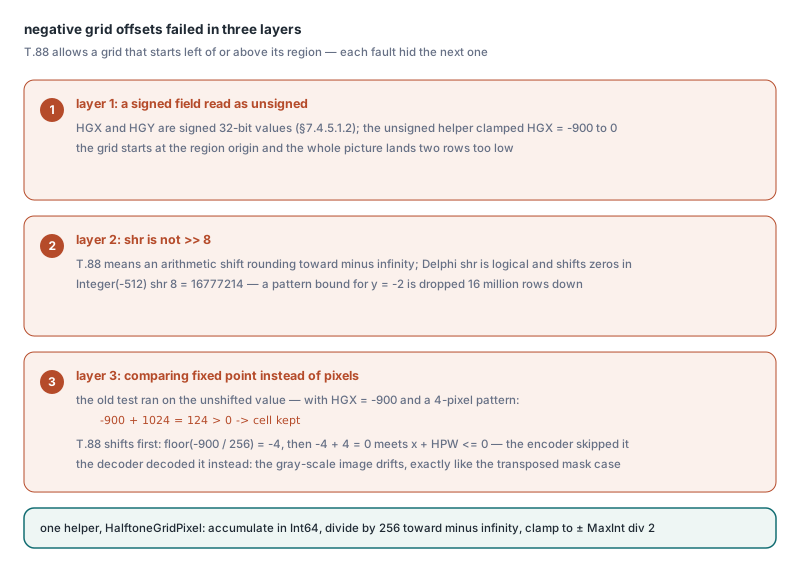
A halftone grid that starts left of or above its region broke PDFlibPas in three separate places, and each fault hid the next one. T.88 allows this geometry deliberately. An encoder that aligns its screen to the page rather than to the region, or uses a rotated grid, naturally produces negative cell corners that the region crops. v3.539.38 fixed all three layers together, because fixing any one alone only changed the symptom
Layer 1: a signed field read as unsigned
T.88 §7.4.5.1.2 defines HGX and HGY as signed 32-bit values, but the decoder read them with the same 32-bit helper it used for unsigned fields, and that helper clamped every negative result to 0. A grid meant to start at HGX = -900 was quietly moved onto the region origin. In the v3.539.38 regression case the whole picture came out two rows too low. The clamp also explains why the other two faults survived so long: with the origin forced to be non-negative, a negative coordinate could only appear through a rotated grid with HRY > 0, where y = HGY + mg × HRX − ng × HRY drops below zero for later grid columns
Layer 2: shr is not >> 8
T.88 writes >> 8 and means an arithmetic shift, which rounds toward minus infinity. The decoder translated it as shr 8. In Delphi and Free Pascal, shr on a signed integer is a logical shift: the sign bit is shifted in as a zero. For an Integer holding -512, shr 8 yields 16777214 instead of -2. A pattern that should have been drawn at y = -2 and cropped to its lower half was sent 16 million rows down and dropped as off-region. Nothing crashed; the top row of the halftone simply vanished
Layer 3: comparing fixed point instead of pixels
The skip test compared fixed-point values, not pixel positions, and the two are not equivalent once the fraction is non-zero. The original code dodged the logical shift by testing xx + HPW × 256 <= 0 on the unshifted value, a supposed equivalent of the T.88 test. With HGX = -900 and a 4-pixel pattern, that gives -900 + 1024 = 124, which is positive, so the cell is not skipped. The standard shifts first: floor(-900 / 256) = -4, and -4 + 4 = 0 meets x + HPW <= 0, so the cell lies entirely outside and must be skipped. The encoder skipped it, the decoder decoded it, and the gray-scale image drifted exactly as in the transposed-mask case
The regression case from v3.539.38 uses a 4 × 3 grid of 4 × 4 patterns at HGX = -900, HGY = -512, HRX = 1024 on a 12 × 10 region. Grid columns land at x = -4, 0, 4 and 8, so column 0 is entirely outside and belongs in HSKIP; grid rows land at y = -2, 2 and 6, so row 0 must be cropped to its lower two pixel rows rather than dropped. Fixing the layers one at a time reproduces the stack:
| Faults fixed | Decoded region |
|---|---|
| None (before v3.539.38) | Grid pulled to the origin, whole picture two rows too low |
| Signed HGX / HGY read only | First grid row missing, the rest garbled by the skip-test drift |
| Signed read, floor shift and pixel-space skip test | Identical, pixel for pixel, to the page computed from T.88 §6.6.5 and to two independent reference decoders |
The fix is one helper, HalftoneGridPixel, shared by the skip-mask builder and the placement loop. It accumulates the coordinate in Int64 so a large mg × HRX product cannot wrap, divides by 256 rounding toward minus infinity, and clamps to ±MaxInt div 2 so a corrupt grid cannot overflow later bitmap arithmetic. The skip test now compares those pixel values against HPW, HPH, HBW and HBH, exactly as §6.6.5.1 states it
How do you write an arithmetic right shift in Delphi?
Delphi has no arithmetic shift operator, so a correct signed right shift has to be written as a floor division, and plain div is not that division. div truncates toward zero. For non-negative values truncation and floor agree, and they also agree for negative values that are exact multiples of the divisor, which is why -512 div 256 = -2 looks fine in a quick test. They disagree everywhere else: -900 div 256 is -3, while the floor is -4, and -1 div 256 is 0, while the floor is -1. A JBIG2 coordinate with a non-zero fraction is exactly the case where div gives the wrong pixel
On the Delphi Win32 and Win64 compilers, an Integer variable holding -512 shifted right by 8 gives 16777214, and an Int64 holding -512 gives 72057594037927934. Free Pascal also defines shr as a logical shift and ships SarLongint and SarInt64 in its System unit for the arithmetic version, but those functions do not exist in Delphi, so code shared between the two compilers needs its own helper:
// Floor division: rounds toward minus infinity for any sign of A and B.
// B must not be 0, and FloorDiv(Low(Integer), -1) overflows just like div
function FloorDiv(A, B: Integer): Integer;
begin
  Result := A div B;
  if (A mod B <> 0) and ((A < 0) <> (B < 0)) then
    Dec(Result);
end;

// Arithmetic right shift (the C and T.88 ">>" on signed values).
// For negative Value, not Value = -Value - 1 is non-negative, so the
// logical shr is safe there, and the outer not maps the result back
function SarInt32(Value: Integer; Shift: Integer): Integer;  // Shift 0..31
begin
  if Value >= 0 then
    Result := Value shr Shift
  else
    Result := not ((not Value) shr Shift);
end;

function SarInt64(Value: Int64; Shift: Integer): Int64;      // Shift 0..63
begin
  if Value >= 0 then
    Result := Value shr Shift
  else
    Result := not ((not Value) shr Shift);
end;
The not trick never shifts a negative number, so it does not depend on how a compiler treats the sign bit, and it never overflows, including for Low(Integer). Both helpers matched an Int64 floor reference over several million values, every shift from 0 to 31 and the Low(Integer) and High(Integer) edges on Delphi Win32, Delphi Win64 and Free Pascal x86_64. A sanity check worth keeping in any unit test that touches coordinates:
var
  V: Integer;
begin
  V := -900;
  Writeln(V shr 8);           // 16777212  logical shift, the old bug
  Writeln(V div 256);         // -3        truncation toward zero
  Writeln(FloorDiv(V, 256));  // -4        what T.88 means by >> 8
  Writeln(SarInt32(V, 8));    // -4
end;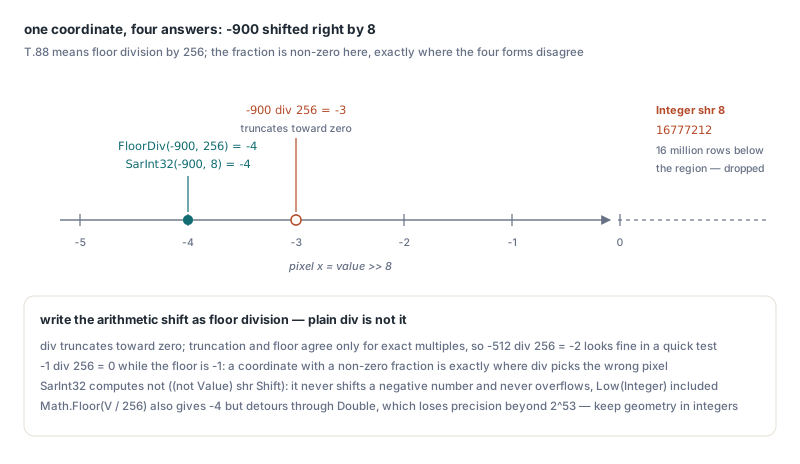
Math.Floor(V / 256) also returns -4, but its detour through Double loses precision for Int64 values above 253, so integer geometry should stay in integers
Which PDFlibPas calls run the halftone decoder?
The JBIG2 halftone decoder runs when PDFlibPas renders a page with the built-in renderer, because rendering needs pixels. RenderPageToFile and RenderPageToStream both reach it through the page's JBIG2Decode image streams, so re-rendering a halftone page is the direct way to confirm that v3.539.38 changes your output. The same decoder handles the other JBIG2 region types, covered in JBIG2 custom Huffman tables in the pure Pascal decoder and decoding random-access JBIG2 files in Delphi, and the rendered bitmap feeds conversions such as rendering PDF pages to 1-bit monochrome
uses
  SysUtils, PDFlibrary;

var
  Lib: TPDFlib;
  Page: Integer;
begin
  Lib := TPDFlib.Create;
  try
    if Lib.LoadFromFile('scanned-halftone.pdf', '') <> 1 then
      raise Exception.CreateFmt('Load failed, error %d', [Lib.LastErrorCode]);
    for Page := 1 to Lib.PageCount do
      // Rendering decodes every JBIG2 region, halftones included
      if Lib.RenderPageToFile(150, Page, PDF_RENDER_PNG,
        Format('page-%.3d.png', [Page])) <> 1 then
        Writeln('Page ', Page, ' was not rendered');
  finally
    Lib.Free;
  end;
end.
Image extraction normally takes a different path. GetPageImageList returns JBIG2 images in native form, and SaveImageListItemDataToFile or GetImageListItemDataToString hands you a standalone JBIG2 file built from the stream bytes: the file header, the JBIG2Globals data and an end-of-file segment around the page data. Property 400 of GetImageListItemIntProperty reports 6 for such an item. Nothing is decoded on that path, so an extracted .jb2 that looks correct in another viewer while the rendered page shows noise was a typical sign of these two halftone bugs:
var
  ListID, I: Integer;
begin
  Lib.SelectPage(1);
  ListID := Lib.GetPageImageList(0);
  if ListID = 0 then
    Exit;
  try
    for I := 1 to Lib.GetImageListCount(ListID) do
      if Lib.GetImageListItemIntProperty(ListID, I, 400) = 6 then  // standalone JBIG2
        Lib.SaveImageListItemDataToFile(ListID, I, 0,
          Format('page1-image%d.jb2', [I]));
  finally
    Lib.ReleaseImageList(ListID);
  end;
end;
When masks or color conversion force a rendered fallback, the item comes back as a decoded bitmap and the halftone decoder does run. More on image lists is in Delphi PDF text, image and font extraction
Quick reference: JBIG2 halftone grid rules
- Index the skip mask as
HSKIP[ng, mg], grid column first, and read it back in the same order wherever cells are placed (T.88 §6.6.5.1, fixed in PDFlibPas v3.539.37) - Test any halftone or grid code with a non-square grid and an asymmetric set of out-of-region cells, because a square grid can hide a transposed index completely
- Read
HGXandHGYas signed 32-bit values (T.88 §7.4.5.1.2), never through an unsigned helper that clamps negatives - Translate the standard's
>> 8as a floor division by 256, not asshr 8and not asdiv 256 - Run the skip test on shifted pixel positions; the fixed-point form differs whenever the fraction is non-zero, as
HGX = -900with a 4-pixel pattern shows - Accumulate grid coordinates in
Int64and clamp before handing them to bitmap code, so a corrupt grid cannot overflow - Upgrade to v3.539.38 or later if your documents contain halftone regions with
HENABLESKIP, negative grid origins or rotated grids
PDFlibPas renders, extracts and edits PDF documents from Delphi and C++Builder with a native Pascal JBIG2 decoder that now handles halftone skip masks, negative grid origins and rotated grids as T.88 specifies. See the PDFlibPas Delphi PDF library for features, editions and a trial download