The PDF Catalog dictionary has exactly one required navigation key: /Pages. That key must point to an indirect object of type /Pages, which in turn holds the /Kids array and the total /Count of pages. Take that pointer away and no conforming reader can locate a single page in the file. ISO 32000-1 §7.7.2 is unambiguous on this point: the Catalog shall have a /Pages entry, and the referenced object shall have type /Pages. Files that violate this requirement are not merely non-conforming; they are structurally broken in a way that most parsers handle poorly
What the spec actually says
A minimal conforming PDF has at least three objects. Object 1 is the Catalog, object 2 is the Pages root, and object 3 onwards are individual Page dictionaries. The Catalog points to the Pages root; the Pages root lists its children in /Kids; each Page carries a /Parent back-reference. The whole chain is bidirectional by design, so a parser can start from either end and traverse to any page in O(log n) time for balanced trees
% Minimal conforming structure (ISO 32000-1 §7.7.2)
1 0 obj
<< /Type /Catalog /Pages 2 0 R >>
endobj

2 0 obj
<< /Type /Pages /Kids [3 0 R 4 0 R] /Count 2 >>
endobj

3 0 obj
<< /Type /Page /Parent 2 0 R /MediaBox [0 0 612 792] /Contents 5 0 R /Resources << >> >>
endobj

4 0 obj
<< /Type /Page /Parent 2 0 R /MediaBox [0 0 612 792] /Contents 6 0 R /Resources << >> >>
endobj
The Pages tree can be nested. A document with thousands of pages typically groups pages into intermediate node objects that also carry type /Pages, each with its own /Kids and a /Count reflecting the subtree beneath it. The root node's /Count always equals the total page count. That count is what viewers display in the page-number field before they have parsed a single page, because reading one integer from object 2 is much cheaper than walking the entire tree
What a Pages-less file looks like
Files missing the Pages dictionary typically originate from PDF generators that write page objects directly without assembling them into a tree, or from corruption that removes the root node while leaving the leaf Page objects intact. The Catalog in such a file either lacks the /Pages key entirely, or holds a reference to an object that no longer exists in the cross-reference table
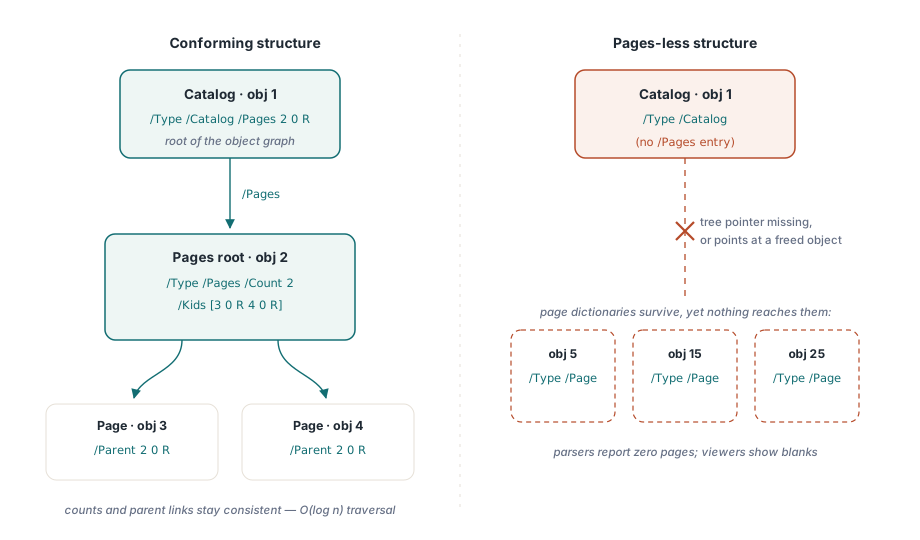
/Pages root, while a Pages-less file abandons intact page objects with no navigable entry from the Catalog% Non-conforming: Catalog with no /Pages reference
1 0 obj
<< /Type /Catalog >>
endobj
% Page objects exist but are unreachable from the Catalog
5 0 obj
<< /Type /Page /MediaBox [0 0 612 792] /Contents 6 0 R /Resources << >> >>
endobj
15 0 obj
<< /Type /Page /MediaBox [0 0 612 792] /Contents 16 0 R /Resources << >> >>
endobj
25 0 obj
<< /Type /Page /MediaBox [0 0 612 792] /Contents 26 0 R /Resources << >> >>
endobjA parser that follows the spec will read the Catalog, attempt to resolve /Pages, find nothing (or a dead reference), and either raise an error or report zero pages. What it must not do is continue as if the file had zero pages and silently succeed; that produces a blank output that looks correct to automated tooling and wrong to every human who opens it
Why parsers crash
Most PDF parsers allocate their internal page table at load time based on the /Count value from the Pages root. When that root is absent, the parser either reads zero, allocates nothing, and then dereferences a null pointer the first time any code asks for page 1, or it reads garbage and allocates a wildly incorrect buffer. Neither outcome is graceful. The access violation at 0x008E5D78 that shows up in crash logs from processing such a file is exactly this: a null-pointer dereference inside the page-access path, triggered by the absence of the structure the parser assumed would always be there
The underlying design assumption is reasonable. The vast majority of PDFs in existence have a Pages dictionary. Parsers that skip the existence check to save a few instructions are not being reckless; they are optimizing for the common case. The files that punish that optimization are rare enough that production code may never encounter one until it does, at which point the crash is both reproducible and baffling if the engineer has not read §7.7.2
Recovery without a Pages tree
If a parser must handle these files rather than reject them, recovery follows a predictable path: scan every indirect object in the cross-reference table, collect those with /Type /Page, and sort them by object number. Object number order is not guaranteed to match reading order in the spec, but in practice, generators that omit the Pages tree tend to emit pages sequentially, so object-number order is correct more often than not
The check itself is cheap. Before walking the Catalog's /Pages pointer, confirm that the pointer exists, that it resolves to a real object, and that the resolved object's /Type equals /Pages. If any of those three conditions fails, fall through to the linear scan. The scan is slower than tree traversal for large documents, because it reads every object header rather than following a balanced path, but it works, and for a file that is already malformed, correctness outranks speed
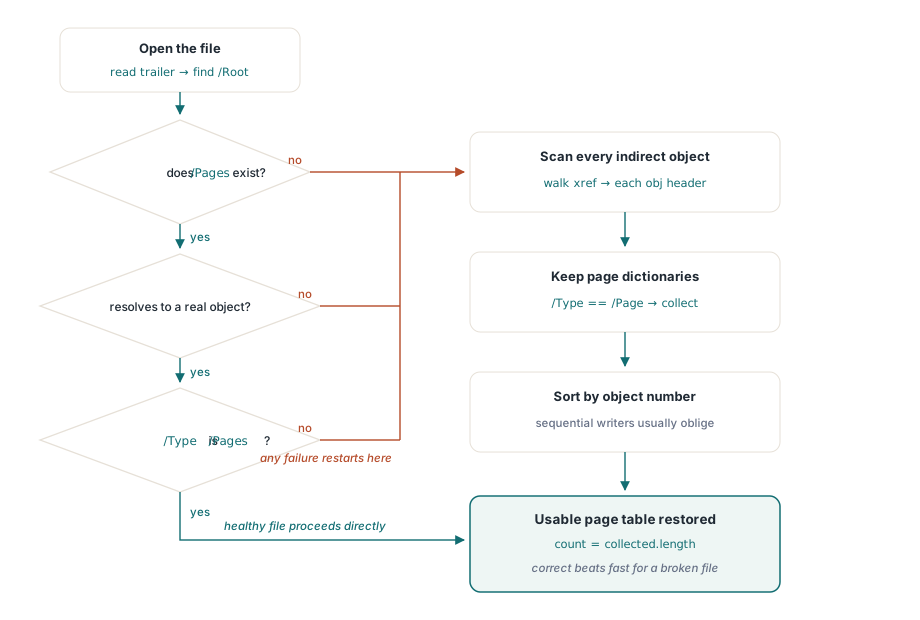
/Pages pointer, and any failure routes the parser into a linear scan that rebuilds the page table by object numberOne edge case that linear scan does not solve automatically: page ordering. Without a /Kids array to define sequence, the "correct" order is undefined by the spec. Object-number order is the pragmatic default; if the file is important enough to process carefully, checking whether the Page objects carry an explicit /StructParents or annotation references that imply a reading sequence is worth the extra work
Implications for PDF generators
For anyone writing a PDF generator rather than a parser, the lesson is narrow: always emit the Pages root before closing the file. The Catalog without a /Pages entry is not a valid PDF under any revision of the spec. Generators that build page objects on the fly and assemble the tree at finalization (the approach most streaming writers use) are fine as long as finalization actually runs. The common failure mode is an exception or early return that aborts the write before the trailer is complete, leaving behind a file that opens in some viewers (which have recovery heuristics) and fails in others (which do not)
PDF/A and PDF/UA impose additional constraints on the page tree beyond what the base spec requires, but neither relaxes the /Pages requirement. A validator that checks conformance to ISO 19005 or ISO 14289 will catch a missing Pages dictionary as a base-spec violation before it even reaches the profile-specific rules